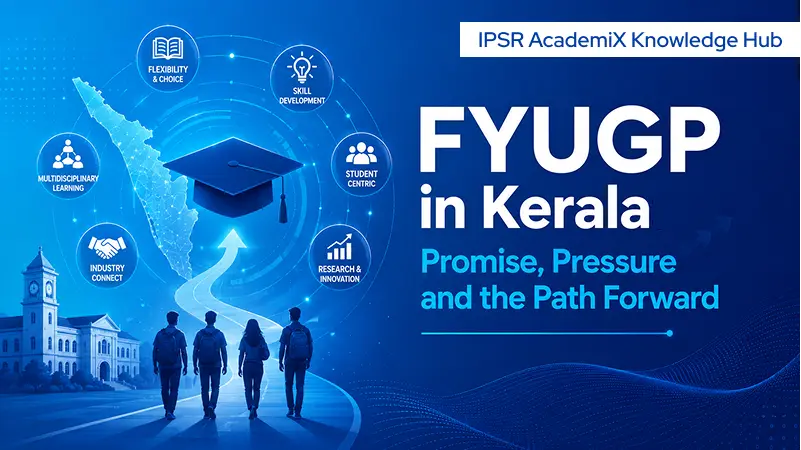
Kerala’s Four-Year Undergraduate Programme is one of the most significant reforms in the state’s higher education landscape. It is not merely a change in duration from three years to four years. It is a deeper shift in how undergraduate education is imagined, delivered, assessed, and experienced.
At its best, FYUGP can make higher education more flexible, multidisciplinary, skill-oriented, research-driven, and student-centred. It can help students move beyond textbook learning and build real capabilities for life, work, higher studies, and society.
But like every major academic reform, the real challenge lies in implementation. Policies may look strong on paper, but their success depends on what happens inside classrooms, laboratories, departments, timetable committees, mentoring sessions, internship cells, and examination systems.
Kerala has the academic tradition and institutional strength to make FYUGP work. But the system needs clarity, patience, practical support, and honest feedback.
The Promise of FYUGP
The intention behind FYUGP is timely and necessary. Today’s students need more than subject knowledge. They need communication skills, digital fluency, problem-solving ability, ethical awareness, teamwork, adaptability, research orientation, and career readiness.
The new structure creates space for major-minor combinations, multidisciplinary learning, skill enhancement courses, internships, research projects, continuous assessment, and flexible academic pathways. These are positive changes.
For many years, undergraduate education has been largely syllabus-driven and examination-driven. FYUGP gives Kerala a chance to move towards capability-driven education. This is a good direction. But the road is not easy.
Key Issues in Implementation
- OBE is still a challenge for many teachers
Outcome-Based Education is central to FYUGP. However, many teachers are still trying to understand how to design Programme Outcomes, Programme Specific Outcomes, and Course Outcomes in a meaningful way.
The difficulty is not only in writing outcomes. The real challenge is mapping outcomes, designing assessments, preparing rubrics, measuring attainment, and documenting evidence. In many cases, OBE risks becoming a paperwork exercise rather than a teaching-learning improvement process.
This affects everyone. Teachers feel burdened, students may not understand the competencies they are expected to develop, and institutions may focus more on files than actual academic transformation.
- Orientation is still insufficient
FYUGP has introduced new structures, new terminology, new credit requirements, new course choices, new assessment methods, internships, research components, and multiple pathways.
Many teachers and students need more practical orientation. A single workshop or circular cannot create full understanding. Students need clarity before choosing courses. Teachers need clarity before mentoring them. Parents also need simple explanations, especially regarding multiple entry and exit options.
Without proper orientation, confusion grows. Students may make poor course choices. Teachers may struggle to guide them. Institutions may implement the reform unevenly.
- Skill Enhancement Courses need more practice
Skill Enhancement Courses are one of the most promising parts of FYUGP. But in some places, SEC courses are being handled like regular theory papers.
This is a serious concern. SEC courses should not become another set of notes, lectures, and written examinations. They should build visible skills.
A communication skills course must include speaking practice, presentations, group discussions, interviews, and feedback. A digital skills course must include lab work and real tool usage. Entrepreneurship courses should include idea development, market study, case analysis, and field interaction. Community-based courses should include actual community engagement.
Every SEC course should answer one simple question: What can the student do after completing this course?
- Infrastructure and workload pressures are real
FYUGP requires more than academic enthusiasm. It needs classrooms, laboratories, ICT facilities, library support, mentoring spaces, timetable flexibility, internship coordination, and trained faculty.
Many affiliated colleges are trying to implement a flexible academic model with limited resources. This creates pressure. Teachers are expected to handle teaching, mentoring, continuous assessment, OBE documentation, project guidance, internship support, and administrative reporting.
If workload norms are not revised, teacher burnout will become a real issue. A reform that depends heavily on teachers must also protect teachers’ time and energy.
- Timetabling and course choice are difficult in practice
FYUGP promises flexibility. But flexibility is difficult to deliver when colleges have limited faculty, limited classrooms, and fixed working hours.
Students may be told that many options exist, but in practice only a few may be available. Timetable clashes can restrict choice. Mixed-discipline classes can become difficult to manage without proper planning.
This gap between promise and practice can affect student confidence in the reform.
- Internships need stronger systems
Internships can be transformative if they are meaningful, supervised, and connected to learning outcomes. But if internships are treated as a formality, they lose value.
Many affiliated colleges may not have enough industry, alumni, NGO, local body, or research linkages to provide good internship opportunities. Students from rural or economically weaker backgrounds may face additional barriers.
Internship quality should not depend only on a student’s personal contacts. Colleges and universities must help create fair, accessible, and academically relevant internship pathways.
- Continuous assessment must support learning
Continuous assessment is useful when it gives students regular feedback and helps them improve. But if it becomes only frequent tests, repeated assignments, and marks entry, it can become stressful.
Teachers need support to design meaningful assessment activities such as presentations, case studies, portfolios, seminars, lab tasks, field reports, reflective writing, and mini projects.
Students should experience continuous assessment as continuous learning, not continuous pressure.
- Higher-order skills are difficult to assess
FYUGP expects students to develop critical thinking, creativity, communication, teamwork, research ability, ethical reasoning, and problem-solving skills. Traditional written examinations alone cannot measure these abilities.
Teachers need rubrics and assessment models for project work, presentations, group activities, field engagement, internships, and research tasks. Without such tools, higher-order skills may remain beautifully written in documents but weakly developed in practice.
- Implementation is uneven across colleges
Not all colleges have the same level of readiness. Some institutions have strong infrastructure, leadership, faculty strength, ICT systems, alumni networks, and industry linkages. Others are still struggling with basic requirements.
This creates uneven student experiences. One student may enjoy real flexibility, practical learning, internships, and mentoring. Another student may experience confusion, limited choice, and excessive paperwork.
A state-level reform must be sensitive to these differences.
- Administrative burden can reduce academic focus
Teachers are the heart of FYUGP implementation. If they are overloaded with excessive forms, repeated documentation, duplicated reports, and unclear instructions, teaching quality will suffer.
Documentation is necessary, but it should be simple, purposeful, and useful. The system should trust teachers and support them, not drown them in paperwork.
Emerging Best Practices
Despite these challenges, several positive practices are visible.
Many institutions have started restructuring curricula with better attention to multidisciplinary learning, skill development, internships, and research. This is a welcome shift from rigid subject-based education.
OBE awareness is also improving. Some departments are beginning to align course outcomes with teaching methods and assessments. This can gradually improve academic quality.
Teacher orientation programmes, faculty development sessions, and workshops have helped create initial awareness. These efforts should continue, but with more hands-on training.
The use of LMS and ICT tools has also improved in many colleges. Digital platforms are helping teachers share resources, conduct quizzes, collect assignments, and provide feedback.
Mentoring systems are becoming stronger. In some institutions, teachers are actively guiding students on course selection, academic progress, internships, higher studies, and career planning.
There are also promising examples of interdisciplinary courses, student presentations, field visits, community engagement, mini projects, case studies, innovative assessment practices, and internship initiatives.
These are not small achievements. They show that FYUGP can work when institutions combine policy clarity with academic commitment.
Suggestions for the Future
- Provide practical OBE training
Teachers need hands-on training in writing outcomes, mapping COs with POs and PSOs, designing rubrics, preparing assessment plans, calculating attainment, and maintaining simple course files.
Training should focus on the actual process of implementation, supported by discipline-wise best practices, sample course plans, model assessments, rubrics, activity designs, and evidence of how OBE can be meaningfully applied in each subject area.
- Simplify documentation
OBE documentation should be simple and useful. It should help teachers improve learning, not merely satisfy inspection requirements.
Universities can provide model formats for course outcomes, mapping, rubrics, lesson plans, internship evaluation, and attainment reports. These formats should reduce confusion and avoid duplication.
- Make SEC courses truly skill-based
Every SEC course should include practical components. There should be activities, labs, fieldwork, demonstrations, simulations, presentations, portfolios, or projects.
Assessment should measure performance, not memory alone. The aim should be clear: each student must gain a demonstrable skill.
- Revise workload norms
Mentoring, continuous assessment, project supervision, internship coordination, interdisciplinary teaching, and OBE work require time. These responsibilities should be officially recognised in workload planning.
Without realistic workload norms, teachers will carry the reform on personal sacrifice. That is not sustainable.
- Improve infrastructure
Colleges need better laboratories, ICT facilities, classrooms, internet access, libraries, and student support systems. Infrastructure planning should match the academic expectations of FYUGP.
Skill courses without facilities, internships without networks, and research projects without guidance will weaken the reform.
- Strengthen mentoring
Every student should receive clear academic guidance. Student handbooks, orientation sessions, mentor meetings, and parent awareness programmes can reduce confusion.
Mentoring should help students understand course choices, credit requirements, assessment patterns, internships, research options, and career pathways.
- Build internship and community linkages
Universities and colleges should work with industries, alumni, local self-government bodies, NGOs, start-ups, research centres, and professional organisations.
Internships should include work diaries, supervisor feedback, student reflection, and final presentations. This will make them more meaningful and accountable.
- Encourage project-based learning
FYUGP should promote learning by doing. Courses should include mini projects, field studies, lab work, case analysis, community problem-solving, presentations, and reflective assignments.
This approach will help students apply knowledge and build confidence.
- Allow reasonable academic flexibility
Affiliated colleges need flexibility based on their strengths, location, faculty expertise, and student profile. A rigid one-size-fits-all model may not work.
Colleges should be allowed to design locally relevant skill courses, internships, value-added activities, and community projects within a clear academic framework.
- Create feedback-based improvement
FYUGP should be reviewed regularly using feedback from students, teachers, principals, employers, alumni, and community partners.
The purpose of monitoring should be improvement, not fault-finding. A reform of this size must evolve through listening.
Conclusion
FYUGP is a bold and necessary step for Kerala higher education. Its vision is strong: flexibility, multidisciplinary learning, skill development, research orientation, OBE, internships, and student-centred education.
But vision alone is not enough. Teachers need training. Students need guidance. Colleges need infrastructure. Universities need to provide clarity. Documentation must be simplified. SEC courses must become genuinely practical. Workload norms must become realistic.
Kerala has always valued education deeply. FYUGP can build on that legacy if it is implemented with wisdom, care, and ground-level understanding.
The goal should not be to complete a reform on paper. The goal should be to build graduates who are knowledgeable, skilled, confident, ethical, employable, and socially responsible.
That is where FYUGP can truly make a difference.