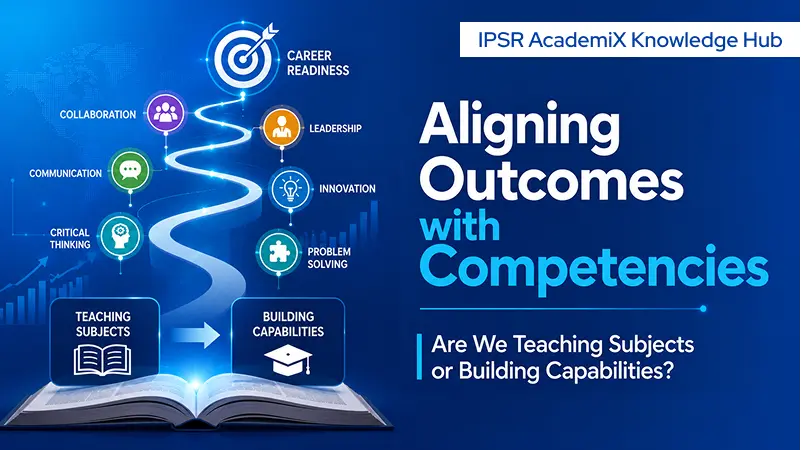
Walk into any faculty development programme on Outcome-Based Education (OBE), and sooner or later the discussion turns to Course Outcomes, Program Outcomes, attainment calculations, and accreditation requirements. Faculty members diligently write outcomes, map them to Program Outcomes, and prepare assessment plans. Yet one important question often remains unanswered:
When a student successfully completes our course, what are they actually capable of doing?
This question lies at the heart of Outcome-Based Education.
Over the years, while interacting with faculty members across engineering, science, management, and computer applications programmes, I have noticed a recurring challenge. Most educators can write course outcomes. Many can map them to graduate attributes. However, fewer are able to clearly explain how those outcomes help students develop meaningful competencies.
And that is where the real power of OBE lies.
OBE is not merely about documenting outcomes. It is about ensuring that every learning experience contributes to building the capabilities students need for their careers, their professions, and life itself.
The Gap Between Knowing and Doing
Think about a student who has completed a course in Database Management Systems.
The student may be able to define normalization, explain primary keys, and answer examination questions on SQL. But can the student design a database for a hospital, a school, or an e-commerce company?
If the answer is no, then we have successfully taught knowledge, but we may not have developed competency.
This distinction is important.
Knowledge is what students know.
Competency is what students can do with what they know.
Employers rarely recruit graduates because they can reproduce textbook definitions. They recruit graduates because they can solve problems, communicate ideas, make decisions, work in teams, and adapt to new situations.
That is why modern education is increasingly shifting its focus from content delivery to competency development.
Outcomes and Competencies: Understanding the Difference
The terms "outcomes" and "competencies" are often used interchangeably, but they are not the same.
A learning outcome describes a specific achievement expected at the end of a course or learning experience.
For example:
"Analyze the performance of sorting algorithms using appropriate complexity measures."
This is measurable and assessable.
A competency, on the other hand, is broader.
It combines knowledge, skills, attitudes, and behaviours that enable effective performance in real-world situations.
For example:
-
Problem-solving competency
-
Communication competency
-
Research competency
-
Leadership competency
-
Ethical decision-making competency
A competency is not developed through a single lecture or even a single course. It is cultivated gradually through multiple learning experiences across a programme.
Consider communication competency.
A student develops communication skills through presentations, seminars, group discussions, project reviews, internships, report writing, and classroom interactions. No single course can claim complete ownership of this competency.
This is why competencies should be viewed as the destination, while learning outcomes serve as milestones along the journey.

Why Alignment Matters More Than Ever
The world our students are entering is changing rapidly.
Information is no longer scarce. Students can access facts, explanations, and tutorials within seconds using search engines and AI tools.
The question is no longer:
"Can students find information?"
The more important question is:
"Can students use information to solve meaningful problems?"
This is where competencies become critical.
A graduate who possesses strong competencies can adapt to changing technologies, work effectively with diverse teams, and continue learning throughout life.
A graduate who possesses only content knowledge may struggle when faced with unfamiliar situations.
This reality has significant implications for educators.
As faculty members, we need to move beyond asking:
-
Have I completed the syllabus?
-
Have I covered every topic?
-
Have students attended my classes?
Instead, we should also ask:
-
What capabilities have my students developed?
-
How do I know they have developed them?
-
What evidence can demonstrate those capabilities?
These questions form the foundation of competency-based OBE.
A Simple Way to Think About Competency Alignment
Whenever you design a course, start by asking a simple question:
"What kind of professional should this course help create?"
For example, in a Data Analytics course, the goal is not merely to teach statistical techniques.
The larger goal is to develop the competency of data-driven decision making.
Once this competency is identified, everything else becomes clearer.
Students should be able to:
-
Interpret data
-
Select suitable analytical tools
-
Identify patterns
-
Draw meaningful conclusions
-
Communicate findings effectively
These observable actions can then be translated into learning outcomes.
Instead of writing:
"Understand data analytics concepts."
We can write:
"Analyze business datasets using statistical tools and interpret results for decision making."
Notice the difference.
The second statement focuses on performance rather than content.
It provides clear evidence of competency development.
Bringing Competencies into Classroom Practice

Many faculty members assume competency development requires a complete redesign of courses. In reality, small changes can make a significant difference.
Consider a traditional assignment.
Students are asked to write short notes on cybersecurity threats.
While this may help reinforce conceptual understanding, it provides limited evidence of competency.
Now imagine a different task.
Students are given a scenario involving a small company facing cybersecurity risks. They are asked to identify vulnerabilities and recommend mitigation strategies.
The content remains similar.
However, the learning experience shifts from remembering information to applying knowledge.
This is where competency development begins.
The same principle applies across disciplines.
A mechanical engineering student should not simply learn design principles but use them to design solutions.
A management student should not merely memorize marketing theories but apply them to business situations.
A science student should not only study research methods but conduct investigations and interpret findings.
The emphasis moves from learning about something to performing something.
The Assessment Question
One of the biggest obstacles to competency alignment is assessment.
Many institutions invest considerable effort in writing excellent outcomes but continue using assessments that primarily measure recall.
This creates a mismatch.
Imagine a course outcome that states:
"Design a database solution for organizational requirements."
If the primary assessment consists of multiple-choice questions, can we confidently claim that students have demonstrated design competency?
Probably not.
Competencies require authentic evidence.
When outcomes involve designing, creating, evaluating, investigating, or solving, assessments should provide opportunities for students to perform those tasks.
Projects, case studies, simulations, presentations, portfolios, laboratory investigations, and real-world problem-solving exercises often provide stronger evidence of competency attainment than traditional examinations alone.
Assessment should answer one question:
"What evidence convinces us that students can actually perform?"
Connecting Competencies with Graduate Attributes

Most accreditation frameworks already provide institutions with a competency framework.
The NBA Graduate Attributes, for example, describe capabilities such as:
-
Problem Analysis
-
Design and Development
-
Investigation
-
Communication
-
Ethics
-
Teamwork
-
Lifelong Learning
These attributes should not remain confined to accreditation documents.
They should influence everyday teaching decisions.
Consider communication skills.
Many faculty members assume communication development is the responsibility of language courses.
However, communication competency can be developed in every discipline.
An engineering student presenting a design project.
A science student explaining research findings.
An MCA student defending a software solution.
A management student pitching a business strategy.
Each of these experiences contributes to communication competency.
The same principle applies to teamwork, leadership, ethics, and problem-solving.
Competencies are everyone's responsibility.
Common Mistakes Faculty Members Make
Through numerous OBE workshops and curriculum reviews, certain patterns emerge repeatedly.
The first mistake is writing outcomes that focus only on knowledge.
Statements such as "understand," "know," and "learn" often fail to capture observable performance.
The second mistake is treating competency mapping as a documentation exercise rather than a curriculum design process.
Faculty members sometimes complete mapping tables simply to satisfy accreditation requirements without considering whether genuine alignment exists.
The third mistake is assessment mismatch.
Even well-written outcomes lose their value if assessments fail to measure the intended competency.
Competency development requires alignment among outcomes, learning activities, and assessments.
If any one of these components is disconnected, the entire system becomes weaker.
The Bigger Purpose of OBE
At its core, Outcome-Based Education is not about forms, templates, attainment calculations, or accreditation visits.
It is about student transformation.
The purpose of education is not merely to transfer information from faculty to students.
The purpose is to help students become capable individuals who can think critically, solve problems, communicate effectively, act ethically, and contribute positively to society.
Competencies represent these capabilities.
Learning outcomes provide the pathway to achieve them.
When outcomes are thoughtfully aligned with competencies, every classroom activity acquires greater meaning. Every assessment becomes purposeful. Every course contributes to a larger vision of graduate development.
And that is ultimately what OBE seeks to achieve.
Final Reflection
The next time you review a Course Outcome, pause for a moment and ask yourself:
"If a student successfully achieves this outcome, what competency has actually been developed?"
If the answer is clear, your outcome is likely aligned.
If the answer is unclear, the outcome may need refinement.
Perhaps the simplest way to remember competency alignment is this:
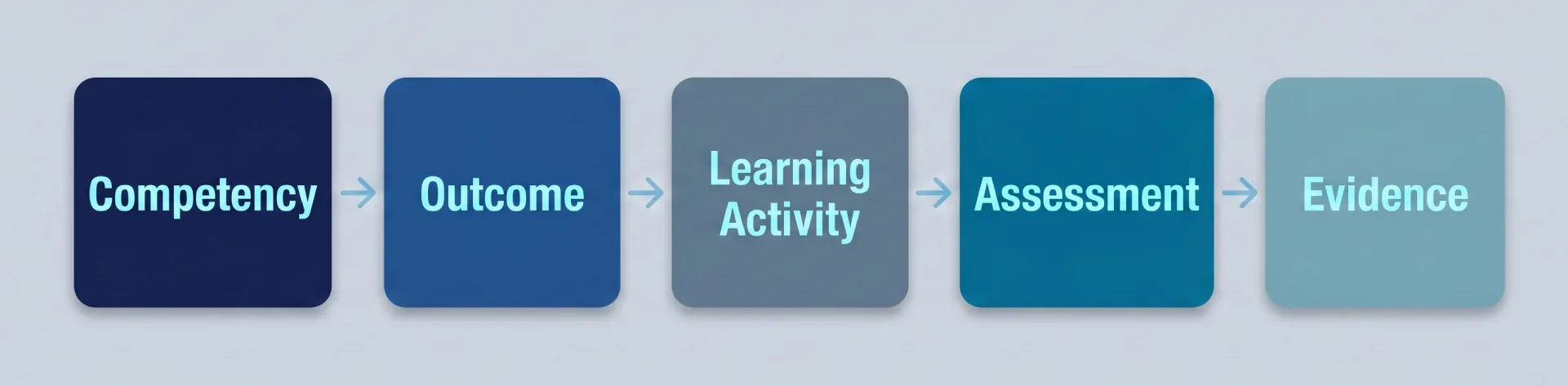
When these five elements work together, education moves beyond teaching content. It begins to shape professionals, innovators, leaders, and lifelong learners.
And that is where Outcome-Based Education truly comes alive.